




Mountain Biking
Why Hitting a Feature Once Doesn’t Mean You’ll Hit It Every Timeaft
Aug
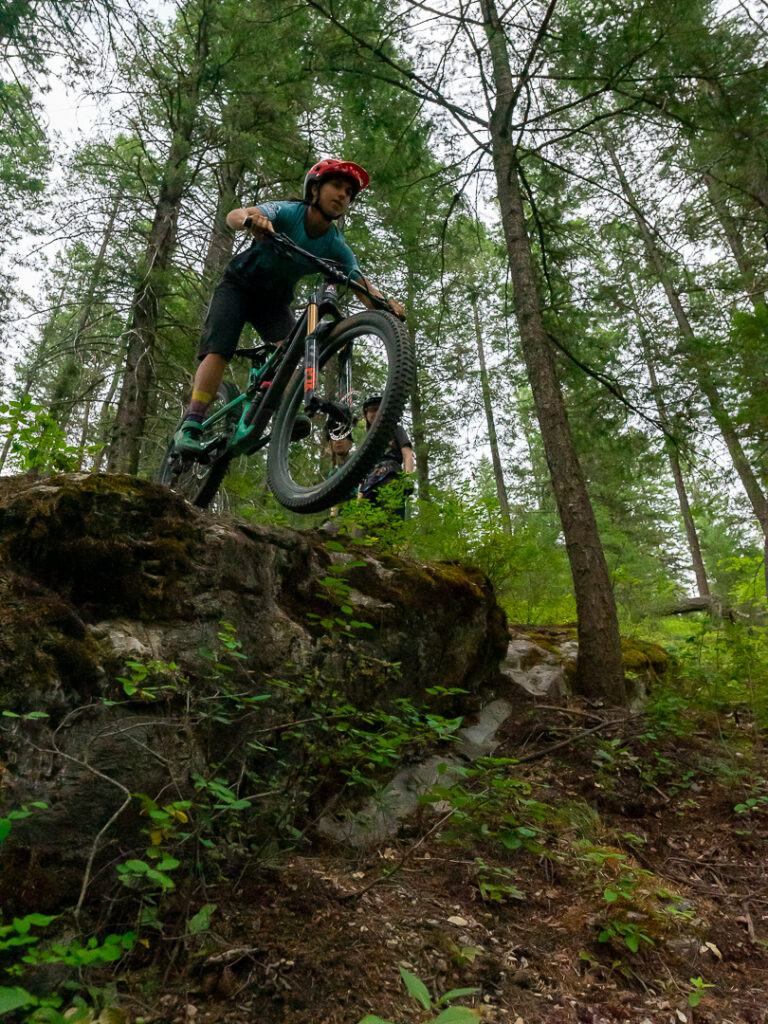
There’s this rock feature I’d been eyeing for a while. I looked at it, walked it, thought about it more than I probably should have. And then one day, I dropped in. I freaking did it!!!! I was so stoked!
A few weeks later I came back and figured I’d just do it again. I’d done it before, after all. I couldn’t do it. I was so frustrated and disappointed in myself.
So next ride, I came prepared. Thought about that feature the entire way up. Told myself I was doing it this time, no question. Placed so much pressure on myself that I froze. This is stupid, I remember thinking. I already did this once, why couldn’t I do it again? Frustration and disappointment set in once again.

After a few sessions with my psychologist Tammy, she gave me some tools on how to overcome the mental side of hitting features. Then one day, riding casual, barely thinking about it, boom. Done.
That’s the cycle, isn’t it? You do it once, expect to do it again, freeze under that expectation, and do it again. Most riders know it. I’ve heard it so many times, coaching or just talking to friends. It points to something we assume without ever really questioning it: that once you’ve done a feature, you should be able to do it every time after.
Yes, it’s possible. But when you’re riding at the edge of your own ability, a lot of things have to go right at once to make it happen. Expecting it to happen every time sets you up for frustration, and frustration is one of the fastest ways to stall your progression. Going in with a curious mind instead of an expectant one keeps the pressure off, and keeps you progressing.

It’s not just you
There’s real science behind why the same feature can feel completely different from one ride to the next, even when nothing about the trail has changed.
Sport psychology research on the arousal-performance relationship shows that arousal and anxiety shape focus, motor skills, decision-making, and resilience. When they’re not managed well, they hurt performance, but when they’re understood and regulated, they can actually help it. There’s a physical mechanism behind that freeze feeling too: too much arousal causes muscle tension and a breakdown in coordination, which is a big part of why your body can lock up on a feature it’s handled cleanly before.
There’s also an attention piece that maps directly onto riding. Research on anxiety and performance has found that when performers are anxious, their gaze behaviour shifts, leading to less efficient visual search. In plain terms, when you’re nervous, your eyes stop tracking your line and start scanning for threat, the rock, the drop, the thing you’re scared of, instead of your exit point. That’s target fixation, and it’s not a character flaw, it’s a documented shift in how the anxious brain processes what it’s looking at.
Add in the everyday variables, stress, hormones (if you track your cycle, you’ll notice this one especially), who you’re riding with, whether the trail’s wetter or drier than last time, how much sleep you got, and it makes sense that “I did it once” was never a guarantee of “I’ll do it every time.”
How to actually progress to the next feature
Doing something once doesn’t mean you’re ready for the next progression. The fastest way there isn’t sending it and moving on, it’s repetition. Ride the same feature, the same line, over and over, until it gets boring. Until it’s almost forgettable. That’s the signal. Then repeat on the next one.
One clean run builds a fragile version of a skill. Riding it again in different conditions, tired, wet, nervous, relaxed, is what makes it stick.
Things that actually helped me
- Remind yourself you’ve done it. Your body has the pattern, even on a day it doesn’t feel like it.
- Quiet your mind. Swap “don’t crash” for something like “focus on your line.”
- Visualize it going well. Not flying off the bike, if that image shows up, notice it and swap it for the version where you land it clean.

Progress looks different for everyone
Some riders need every movement to feel clean before they move on. Others are fine moving on without it being perfect. Neither way is wrong.
I still don’t know, most days, if I’m going to hit that rock feature. I just know I’m not going to let that stop me from rolling up to it anyway.
Sources
- Nieuwenhuys, A., & Oudejans, R. R. D. Anxiety, arousal and visual attention: a mechanistic account of performance variability. Journal of Sports Sciences. https://www.tandfonline.com/doi/abs/10.1080/026404102317284790
- Arousal and Anxiety in Sport Psychology: Understanding, Managing, and Optimising Performance. On Board Sport Psychology. https://onboardsportpsychology.com/2025/11/17/arousal-and-anxiety-in-sport-psychology-understanding-managing-and-optimising-performance/
- Understanding Arousal, Anxiety, and Stress in Sports Psychology (course notes summarizing attentional/visual search research). Studocu. https://www.studocu.com/en-us/document/northern-michigan-university/applied-sports-psychology/arousal-anxiety-and-stress/96581246
- Schmidt, R. Schema theory and variable practice in motor skill learning, as summarized in “Applying different levels of practice variability for motor learning.” PeerJ. https://peerj.com/articles/17575/
- Dissociable effects of practice variability on learning motor and timing skills. PLOS ONE. https://journals.plos.org/plosone/article?id=10.1371%2Fjournal.pone.0193580
