



Mountain Bike Lesson
🌱 From Seeds to Blossoms: Understanding How We Really Learn
Jun
Learning a new skill rarely feels the way we expect it to. We assume progress should be linear — that with enough effort, we’ll steadily improve until something clicks. But real learning is messier, more personal, and honestly more interesting than that. It looks less like a straight line and more like a garden: slow to start, sometimes frustrating, occasionally surprising, and deeply rewarding when you finally see something bloom.
This framework — rooted in motor learning research and used by coaches across sport — maps four stages of skill development. Understanding where you are in the process doesn’t just explain why something feels hard. It can completely change how you respond to that difficulty.
🌱 Stage 1: The Seed — Unconscious Incompetence
You don’t know what you don’t know.
A seed sitting in the soil has no idea what it’s capable of becoming. It isn’t failing at being a plant — it simply hasn’t started yet. Early learners are exactly the same. At this stage, you’re riding, moving, trying — but you’re largely unaware of the specific skills that separate confident riding from struggling riding.
On the trail, this might look like braking too hard or too late, sitting down through descents without realizing it’s slowing you down, or shifting gears more or less at random. You might actually feel fairly confident at this stage — because you don’t yet know enough to know what you’re missing. Or you might feel confused and overwhelmed, without being able to pinpoint why.
Neither reaction is wrong. The seed doesn’t need to understand photosynthesis to start growing — it just needs the right conditions.
Curiosity is often the first sign of growth.
🌿 Stage 2: The Bud — Conscious Incompetence
You know what you need to learn — but you can’t do it yet.
Something has shifted. The seed has broken through the surface, and now you can see the gap between where you are and where you want to be. This stage is marked by awareness — and awareness, while essential, can also be uncomfortable.
You know you should be standing up through descents. You’ve heard it, you understand it, you’ve even felt the difference. But in the moment, under pressure, your body defaults to old habits. You know that braking earlier gives you more control — but it still feels counterintuitive and slightly terrifying to actually do it. The knowledge is there. The execution isn’t quite keeping up.
This is one of the most important — and most misunderstood — stages of learning. It’s easy to interpret this gap as failure. If I understand what I should do but can’t do it, am I just not good enough? The answer is no. This stage isn’t a sign that something is wrong. It’s a sign that something is working. You’ve grown enough to see the next level. That gap is exactly where improvement lives.
The bud is fragile. It needs the right conditions to keep growing — encouragement, patience, and focused practice on one skill at a time rather than everything at once. Progress here comes through repetition.
👉 “It feels awkward because you’re learning — that’s growth.”
🌸 Stage 3: The Flower — Conscious Competence
You can do the skill — but you have to think about it.
This is where things start to feel genuinely good. The plant is flowering. Your skills are visible, real, and working — you just need to be present and intentional to perform them consistently.
You’re standing through descents when you remember to focus on it. You’re braking smoothly when you give it your full attention. You’re shifting efficiently on climbs — but it still requires conscious thought rather than instinct. The skill is there. It just hasn’t become automatic yet.
What’s important to understand about this stage is that it isn’t a lesser version of mastery — it’s an essential part of the journey. You can’t skip it. Skills have to pass through conscious awareness before they can become unconscious. This is the stage where you do the real work of refinement: not just doing the skill, but learning to do it smoothly, linking it to other skills, applying it across different terrain and conditions.
A flower still needs sunlight and water to fully flourish. At this stage, the coaching focus shifts from “can you do it?” to “can you do it well?” — refining technique, building confidence across varied situations, and starting to connect individual skills into fluid, flowing movement.
👉 “You’ve got the skill — now let’s make it smoother.”
🍃 Stage 4: Seeds Spreading — Unconscious Competence
The skill happens automatically.
This is what people picture when they imagine mastery. Skills that once required your full concentration now happen without conscious thought. You’re adjusting your body position instinctively. You’re braking, shifting, and reading the trail fluidly, your attention freed up to focus on the bigger picture — the line, the flow, the next feature ahead.
But what’s most interesting about this stage is what happens beyond the individual rider. Like a plant releasing seeds on the wind, unconscious competence has a way of spreading. Riders at this stage naturally become teachers and inspirations, not necessarily because they set out to coach, but because their ease and confidence gives others permission to believe they can get there too. They demonstrate possibility.
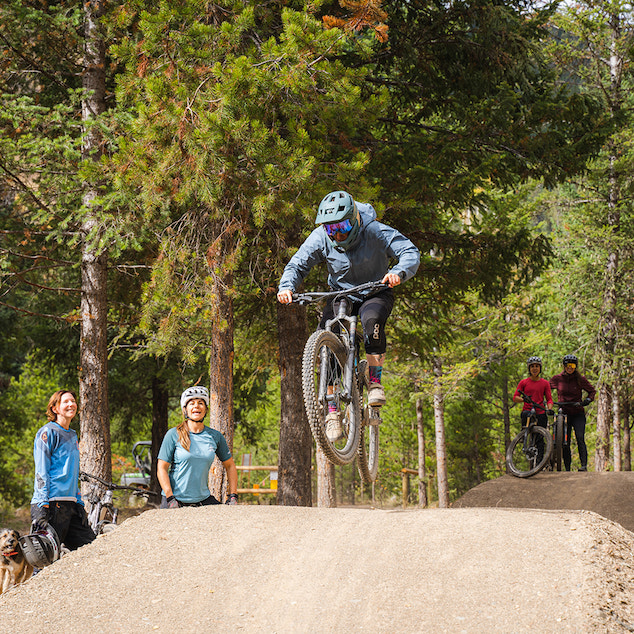
This doesn’t mean the learning stops. Unconscious competence in one skill simply creates the capacity to focus attention on the next challenge — which might throw you right back to Stage 1 in a new area. A rider who flows effortlessly through technical descents might stand at the top of a jump line feeling like a complete beginner again. That’s not regression. That’s the garden continuing to grow.
👉 “Now you ride — not the skill.”
Why This Matters More Than You Think
Understanding these stages isn’t just an interesting theory. It changes how you experience difficulty — and difficulty is unavoidable if you’re actually learning anything.
When something feels awkward, it’s easy to assume you’re not cut out for it, or that you’re falling behind, or that you should already be further along. But awkwardness is almost always a sign that you’re in Stage 2 — that you’ve grown aware enough to see the gap. That’s progress, even when it doesn’t feel like it.
When you have to think hard about something that others seem to do automatically, that’s Stage 3. You’re not slow — you’re building the neural pathways that will eventually make the skill effortless. Every repetition matters, even the imperfect ones.
And crucially — you move through these stages skill by skill, not all at once. On the same ride, you might be a Master/Blossom at blue trails, a Flower at braking technique, a Bud at cornering, and a complete Seed when it comes to jumps. That’s not inconsistency. That’s how learning actually works. Every rider, at every level, is simultaneously a seed and a blossom in different areas.
The goal isn’t to rush to Stage 4 and stay there. The goal is to understand where you are — and meet yourself there with the right kind of attention, patience, and practice.
Based on Fitts & Posner’s stages of motor learning (1967), adapted for MTB coaching.